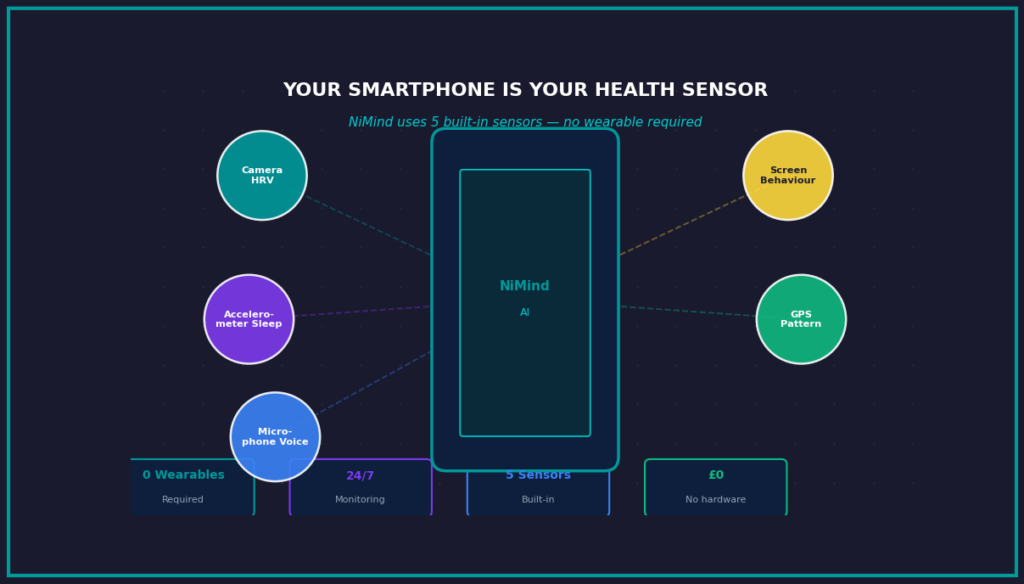
The most-instrumented sensor most people own isn’t a smartwatch or a fitness band. It’s the phone in their pocket. And for the past several years it’s been quietly collecting signals that are surprisingly relevant to mental wellness — without a single extra device, app, or contract.
This post walks through the five most useful of those signals: what they measure, what they actually mean, and what you can do with them. The science is real, the methods are accessible, and the implications for how we think about mental wellness are bigger than most people realize.
A short caveat first: none of these signals diagnose anything. Each one in isolation is noise. What makes them useful is the pattern they form together over days and weeks — the early-warning chord that tells you something is shifting before you feel it consciously.
1. Typing rhythm
When you’re stressed, your typing slows down.
Specifically: the time between individual keystrokes lengthens by 8–14% on average, and the time between words roughly doubles. The autocorrect rate climbs. Backspace usage spikes. These changes are detectable in everyday text input — messages, emails, search queries — without any special software.
This effect has been documented across multiple studies on stress and motor performance, and it’s one of the reasons “behavioral biometrics” has become a serious research field. Apple, Google, and a number of mental-health research labs have all published on it. The signal isn’t subtle; it’s just usually invisible because no one is looking for it.
What you can do with it: notice when your own typing feels effortful. That subjective sense of friction is the same signal a passive monitor would pick up. It’s worth pausing on, even briefly.
2. Screen-on drift at night
The total amount you sleep matters less than most people think. What matters more is consistency — specifically, the two-hour window after your usual bedtime.
If your phone goes from “screen off at 22:30” on weekdays to “screen off at 01:15” on Saturday, the drift is a more reliable predictor of next-day mood than the total sleep duration would suggest. The drift, not the deficit, is the signal.
Researchers in chronobiology call this “social jet lag” — the gap between when your biology wants to sleep and when your social commitments let you. It compounds across the week and is most expensive on Mondays.
What you can do with it: protect the time of your bedtime more than the duration of your sleep. A consistent 23:30 beats a variable 22:00–01:30 most weeks of the year.
3. Voice biomarkers
Your voice carries cortisol-correlated information. When stress is elevated, the timbre, pitch variability, and micro-pause patterns in spoken voice all shift in detectable ways.
A 30-second voice note is enough for trained models to identify the shift in 80%+ of cases — without doing any speech-to-text on what you actually said. The acoustic features alone are sufficient.
This is one of the more promising frontiers in passive mental-health sensing because it works without text content, which means it can preserve a lot more privacy than language-based approaches. The recording stays on the device; only the acoustic features need to be analyzed.
What you can do with it: record a 30-second voice note to yourself periodically. You won’t be able to extract the biomarkers manually, but the act of hearing yourself back is itself a useful self-check. Tone often reveals what content hides.
4. HRV via phone PPG
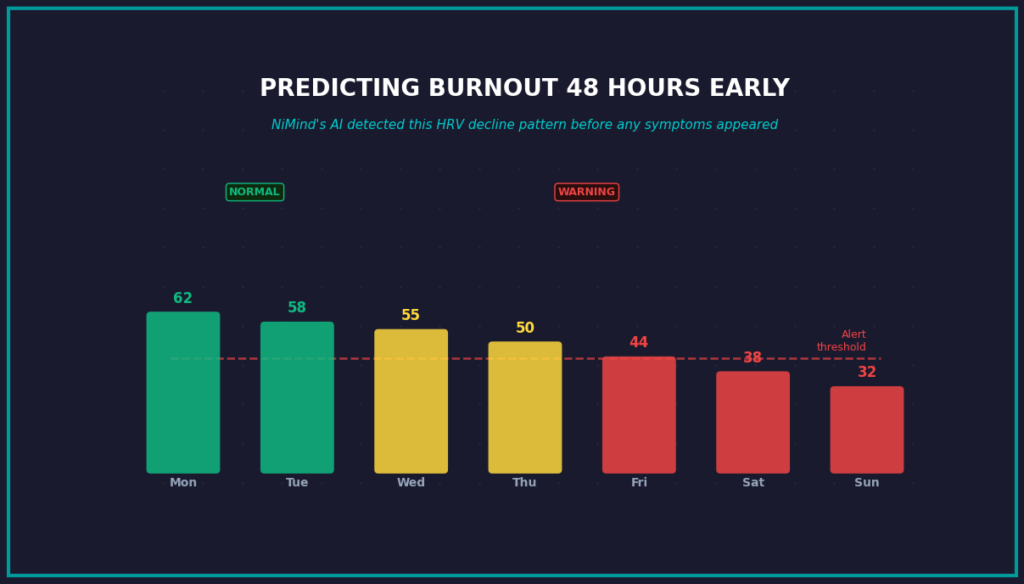
Heart Rate Variability — the millisecond-scale variation between consecutive heartbeats — is one of the most studied non-invasive indicators of autonomic balance and stress recovery. And you can measure it with the camera and flashlight on your phone.
The technique is called PPG: photoplethysmography. You press a fingertip over the camera; the flashlight illuminates the blood beneath your skin; the camera detects the pulse-driven changes in light absorption. From that signal, beat-to-beat intervals can be extracted with reasonable accuracy.
Phone PPG isn’t as precise as a chest-strap ECG, but for tracking trends in resting HRV over weeks and months, it’s plenty good enough. And it’s free — no purchase, no subscription, no extra device on your wrist.
What you can do with it: there are several free apps that run a phone PPG measurement. A 60-second daily reading, taken first thing in the morning before caffeine, will tell you more about your nervous system over a month than most wearables would tell you in a year — because you’ll actually look at it.
5. Movement variability
Step counts are the wellness metric everyone knows about and almost no one uses. Total steps don’t predict much about mental health.
What does predict mental-health changes is the variability in when you move. A day with 8,000 steps clustered into one walk is psychologically different from a day with 8,000 steps spread evenly across the day. Reduced movement variability — long sedentary stretches broken by occasional bursts — is a stronger depression marker than total inactivity.
Your phone’s accelerometer captures this without any special setup. iOS Health and Google Fit both store movement data; what they don’t surface is the distribution across the day.
What you can do with it: aim for movement across the day, not movement totals. A two-minute walk every hour is more useful than a single 45-minute walk that lets you sit for the rest of the day.
Why one signal isn’t enough
Each of these signals can be noisy. A bad night’s sleep can reflect a sick child, not a stress accumulation. Slow typing can reflect a hand cramp, not anxiety. A low HRV reading can reflect last night’s wine, not a longer pattern.
What makes passive sensing useful is the combination. When two or three signals move in the same direction over 48 hours, the probability that something real is shifting goes up considerably. That’s the early-warning chord we mentioned at the top — and it’s the actual point of building wellness tools around passive sensing instead of mood logging.
What this means for mental wellness apps
Most wellness apps today ask you to log how you feel. The problem is that by the time you can describe a mood, the underlying nervous-system pattern that produced it has been building for hours or days. The log catches the symptom, not the cause.
Passive sensing flips this around. Instead of asking you to retrospectively label your state, it monitors the upstream signals that produce the state. The intervention can happen earlier, smaller, and more often — and the pattern view across weeks tells a story that no single mood log can.
This is why we’re building NiMind: a mental wellness companion that reads these signals quietly, on-device, without a wearable. We use four of the five signals above (we don’t currently process voice; that’s coming later in 2026). All processing happens on your phone. Nothing leaves the device unless you explicitly choose to share it.
If that resonates with how you want to approach your own wellness, you can join the wishlist at nimind.com. We’re launching soon on iOS and Android.
Related reading: Passive health tracking from your smartphone · Track sleep quality without a smartwatch