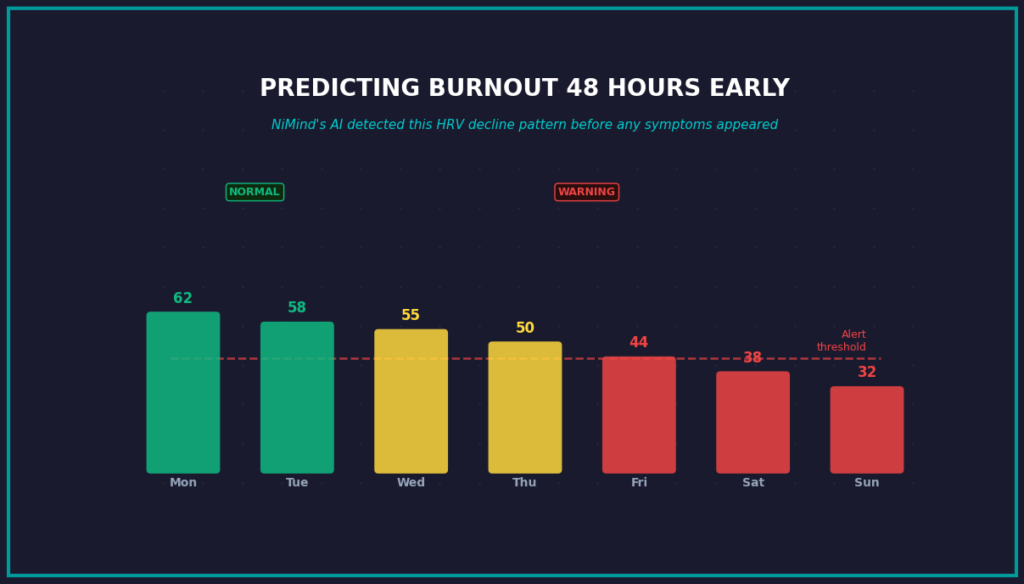
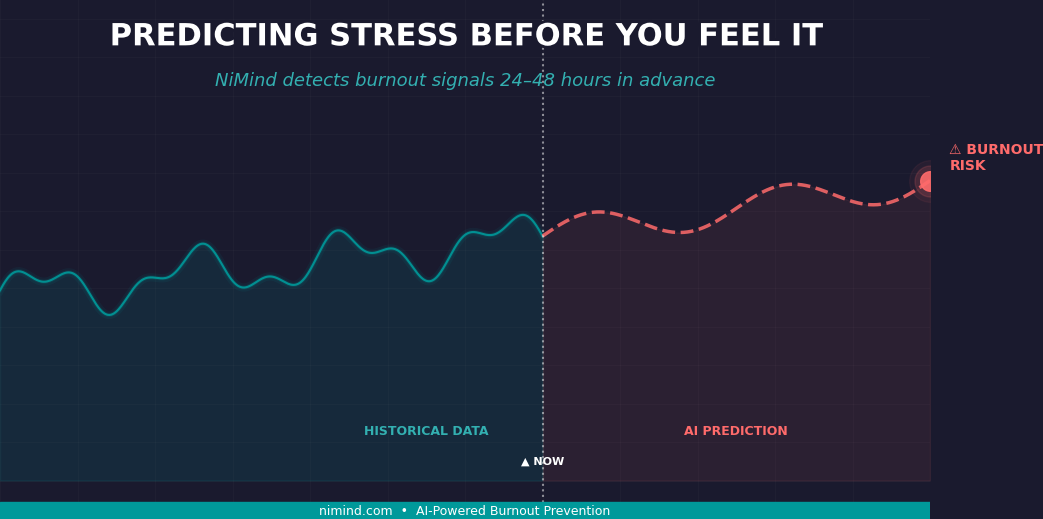
Burnout doesn’t arrive suddenly. It accumulates over weeks and months through a progression of physiological changes that are measurable — objectively, continuously — long before you feel exhausted, cynical, or unable to function. NiMind’s AI stress prediction engine is designed to detect exactly this progression, alerting you to the trajectory you’re on before you hit a wall you can’t immediately recover from.
In this article
- Why burnout is a detection problem, not just a workload problem
- The physiological signature of burnout — and when it becomes visible
- How AI stress prediction works in practice
- What NiMind detects — and what it recommends
Why Burnout Is a Detection Problem, Not Just a Workload Problem
Most burnout conversations focus on causes: too much work, not enough rest, inadequate support, misalignment between values and environment. These are real and important. But there is an equally important dimension that receives far less attention: the detection gap. Most people recognise burnout only after it has already significantly impaired their capacity to function — often weeks or months after the physiological and behavioural warning signs were already present.
This detection gap is not a character flaw. The subjective experience of accumulating burnout is easily rationalised at each individual step — “I’m just tired this week,” “once this project is over I’ll recover,” “everyone is stressed right now.” Objective physiological data doesn’t rationalise. It simply records what’s happening to your body, creating an early warning system that your subjective awareness can’t provide.
“The body signals burnout weeks before the mind admits it. Objective monitoring closes the gap between the physiological reality and the conscious story we tell ourselves.”
The Physiological Signature of Burnout — and When It Becomes Visible
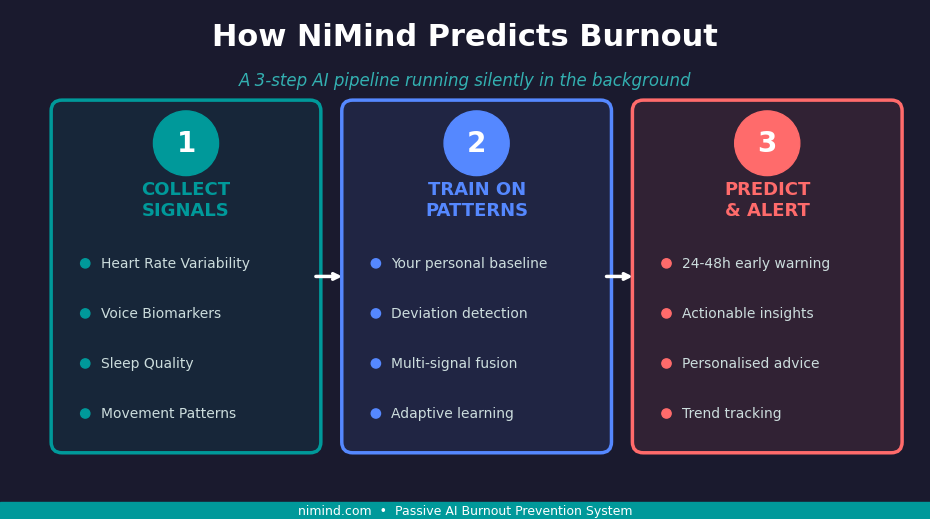
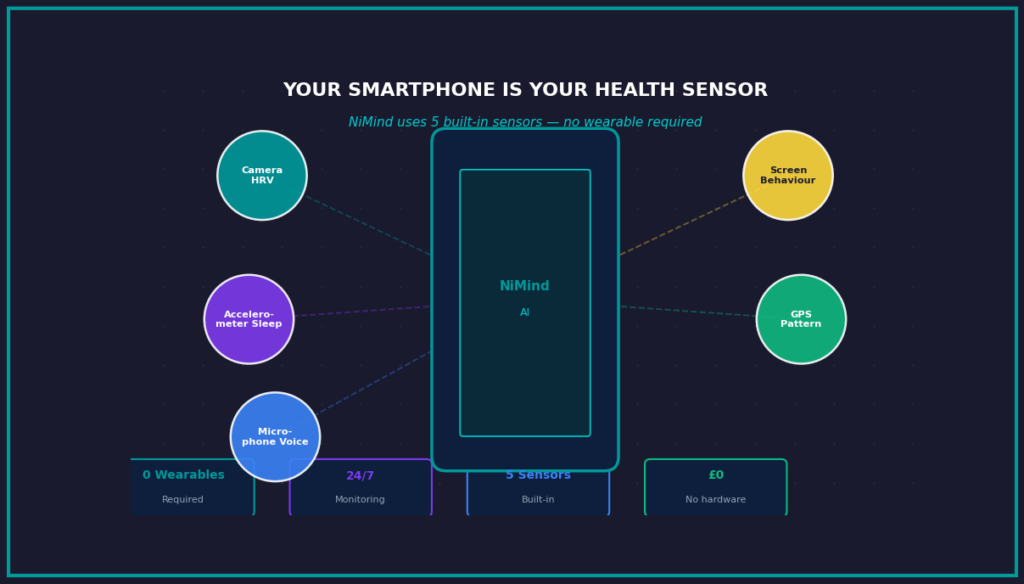
Research on burnout physiology — much of it drawing on the work of Christina Maslach, Dirk Schaufeli, and the occupational health research community — has identified a consistent pattern of physiological change that precedes clinical burnout by weeks. The pattern includes: declining resting HRV (reduced autonomic flexibility), disrupted sleep architecture (reduced slow-wave sleep, increased wake periods), flattened cortisol awakening response, increased voice acoustic stress markers, and reduced physical activity despite maintained subjective motivation.
None of these changes are individually dramatic. Each can be explained away on any given day. But their co-occurrence over a sustained period — 2–4 weeks — is a reliable predictor of imminent burnout in occupational health studies. AI models trained on longitudinal physiological data can detect these multi-signal patterns far more reliably than human self-assessment.
The burnout warning signals NiMind monitors
- HRV trajectory: A sustained downward trend of >10% from personal baseline over 14+ days
- Sleep quality degradation: Declining deep sleep percentage and increasing sleep fragmentation over consecutive nights
- Voice acoustic changes: Reduction in pitch variability and prosodic range — the “flat voice” signature of emotional exhaustion
- Mobility reduction: Declining daily movement radius and physical activity, a behavioural correlate of motivational depletion
- Increased screen time at late hours: Associated with sleep disruption and compulsive distraction behaviour common in pre-burnout states
How AI Stress Prediction Works in Practice
NiMind’s AI models are trained on anonymised longitudinal datasets linking passive smartphone sensor signals to validated burnout and stress assessments (Maslach Burnout Inventory, Perceived Stress Scale, PHQ-9). The models learn the multi-variate patterns that precede stress escalation and burnout onset in real-world populations — not lab conditions — making them more robust to the messiness of daily life.
Each user’s data is first used to establish a personal baseline over 2–4 weeks. The AI then monitors for deviations from this personal baseline rather than comparing you to a population norm. This personalised approach is substantially more accurate than generic benchmarks because it accounts for the enormous individual variation in HRV, sleep architecture, and behavioural patterns.
What NiMind Detects — and What It Recommends
When NiMind’s AI detects a burnout-trajectory pattern, it does three things: alerts you with a clear, plain-language explanation of which signals are trending in concerning directions; provides context about what those trends mean and how confident the model is; and suggests specific, evidence-based micro-interventions calibrated to your current physiological state — not generic wellness advice.
Critically, the goal is not to alarm — it is to create the conditions for an informed choice. You can see your own data, understand the trend, and decide what to do with it. Sometimes the right response is a lighter work week. Sometimes it’s a sleep intervention. Sometimes it’s simply the awareness itself that allows you to approach the next few days differently.
The Bottom Line
AI stress prediction doesn’t prevent burnout by magic — it prevents it by giving you the information you need to act before you’re too depleted to act effectively. The physiological warnings are already there in your body. NiMind makes them visible before it’s too late to do something about them.
Detect Burnout Before You Feel It
NiMind’s AI monitors HRV, sleep, voice, and behaviour passively to predict stress and burnout weeks before they peak. Free to start — no wearable needed.
- HRV and Anxiety: What Heart Rate Variability Tells You About Your Stress
- How AI Is Transforming Mental Health Support in 2025
Related reading: HRV and anxiety: what it reveals about stress · Voice biomarkers and mental health