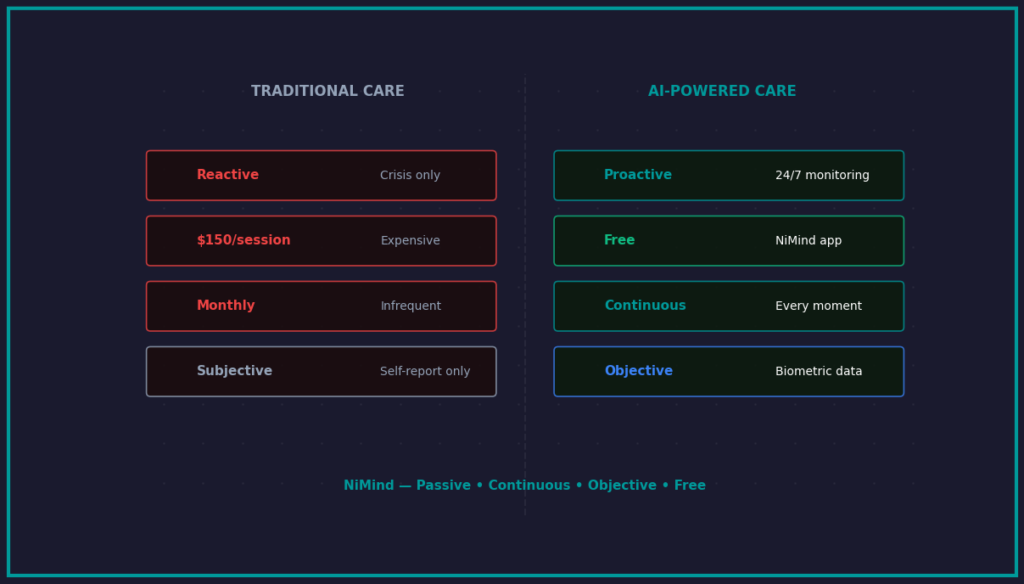
For most of the history of mental health care, the gap between when someone needed help and when they received it was measured in months — or years. AI is compressing that gap in ways that were science fiction a decade ago. In 2025, artificial intelligence is not just improving therapy apps and chatbots; it is fundamentally rewriting what mental health support looks like, who can access it, and how early problems can be detected.
In this article
- The mental health access crisis AI is addressing
- How AI is transforming diagnosis and early detection
- AI-powered therapeutic tools and their evidence base
- The future: personalised, predictive mental health care
The Mental Health Access Crisis AI Is Addressing
The scale of the global mental health burden is staggering. The World Health Organisation estimates that more than 970 million people worldwide live with a mental disorder, yet in high-income countries, up to 50% of people with mental health conditions receive no treatment. In low- and middle-income countries, the treatment gap exceeds 75%. The bottleneck is not lack of demand — it is lack of supply. There are simply not enough trained mental health professionals to meet global need, and there never will be at the rate human training capacity allows.
AI doesn’t replace therapists. But it can extend their reach, provide support between sessions, monitor patients continuously, flag deteriorations early, and deliver evidence-based interventions to populations who would otherwise receive nothing. That is a meaningful contribution to a crisis of global scale.
“AI in mental health isn’t about replacing the therapeutic relationship. It’s about ensuring that the 75% of people who currently receive nothing can access something evidence-based, scalable, and personalised.” — Dr. John Torous, Harvard Medical School
How AI Is Transforming Diagnosis and Early Detection
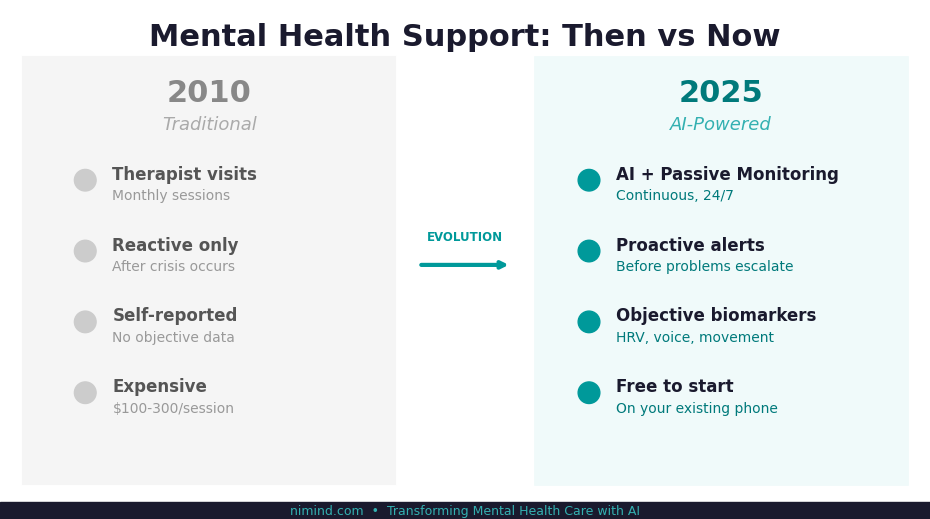
Traditional mental health diagnosis relies heavily on self-report and clinical interview — both of which are subject to recall bias, social desirability effects, and the simple problem that people often can’t accurately describe their own internal states. AI-powered passive monitoring is introducing objective, continuous physiological and behavioural data into this picture for the first time.
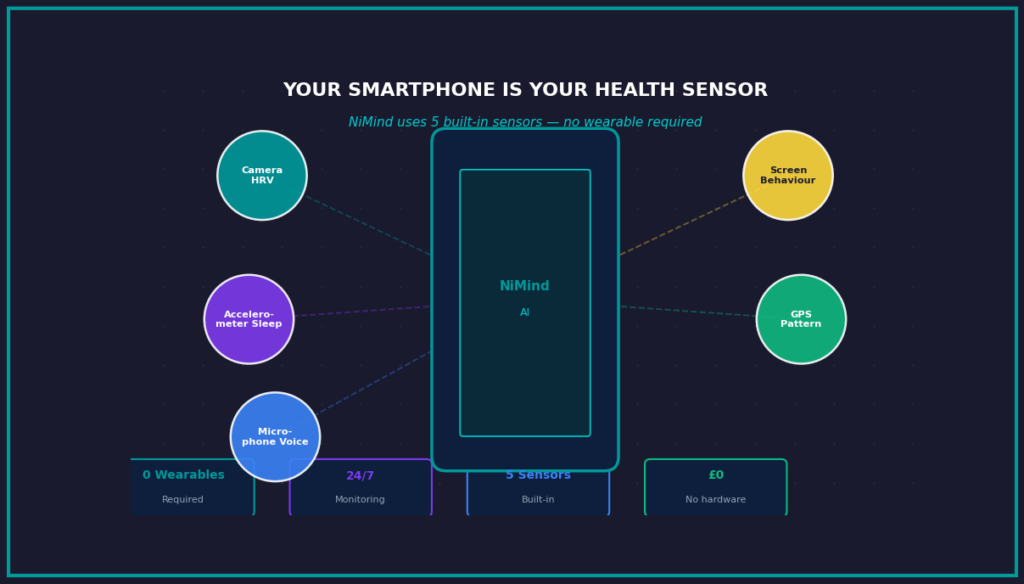
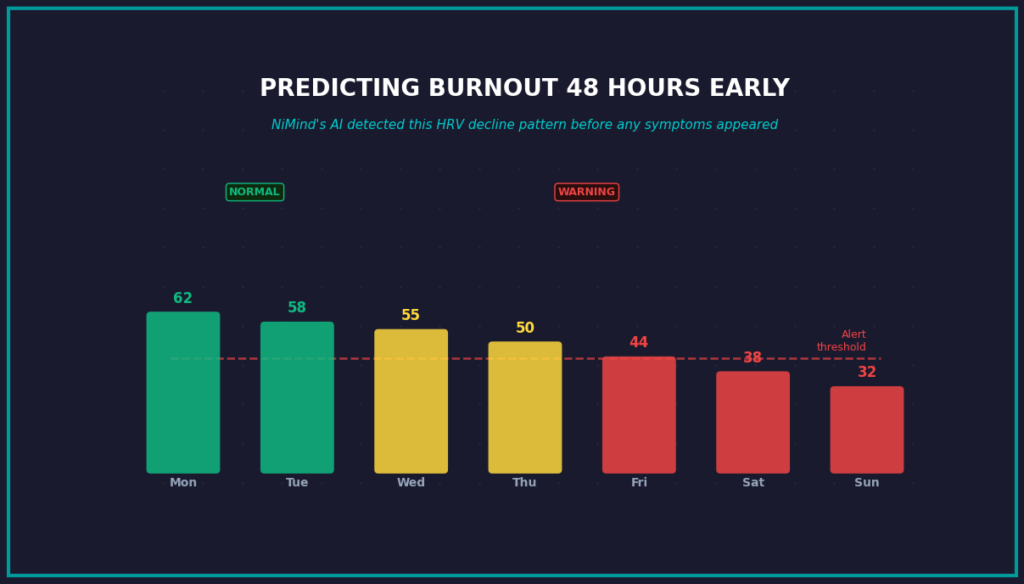
Digital phenotyping platforms analyse smartphone sensor data — GPS mobility, screen time, typing patterns, voice acoustics, HRV — to build quantitative mental health profiles that update daily. Research from Harvard, MIT, and multiple European institutions has demonstrated that these passive signals can predict depression onset, bipolar episode transitions, and psychotic relapse with meaningful accuracy, often days before clinical symptoms become apparent.
AI diagnostic advances in 2025
- Voice AI for depression screening: FDA-cleared voice biomarker algorithms can detect depressive episodes with accuracy approaching clinical structured interviews
- Natural language processing: AI analysis of text messages and speech transcripts identifies semantic features associated with suicidal ideation and psychosis
- Facial action coding: Computer vision systems analyse micro-expressions during video therapy sessions to provide therapists with real-time affect data
- Multi-modal fusion models: The most sophisticated systems combine physiological, behavioural, and linguistic signals for predictions more accurate than any single channel
AI-Powered Therapeutic Tools and Their Evidence Base
AI chatbots for mental health range from simple rule-based systems to sophisticated large language model-powered conversational agents trained on clinical datasets. Woebot — one of the most studied — has published RCT data showing significant reductions in anxiety and depression symptoms in college students compared to waitlist controls. More recent LLM-based systems are demonstrating improved naturalness and better therapeutic alliance metrics in early trials.
HRV biofeedback systems powered by AI personalisation have shown strong evidence for anxiety and stress reduction, adapting breathing guidance protocols to individual autonomic patterns in real time. AI-guided mindfulness platforms, which use physiological feedback to adapt session length, pace, and technique, are demonstrating engagement rates far higher than traditional meditation apps.
The Future: Personalised, Predictive Mental Health Care
The near-term future of AI in mental health is personalisation at scale. Rather than one-size-fits-all treatments assigned by diagnosis, AI will enable treatment matching based on individual biological, psychological, and social profiles — identifying which interventions work best for which subtypes of presentation. This is precision psychiatry, and it is moving from academic concept to clinical reality faster than most expected.
Continuous passive monitoring will shift mental health care from episodic to continuous — from treating crises after they occur to preventing them through ongoing data-driven support. The vision is not dystopian surveillance but autonomous early warning: a personal AI health system that knows your patterns well enough to flag deviations before they become crises.
The Bottom Line
AI is not replacing mental health care in 2025 — it is making mental health care accessible to people who currently have nothing. The combination of passive monitoring, early detection, personalised intervention, and continuous support represents a genuinely transformative shift in how we approach mental wellness at scale. The technology is here. The challenge is deployment.
Experience AI-Powered Mental Wellness Today
NiMind uses AI to monitor HRV, sleep, voice, and behaviour passively — giving you personalised mental wellness insights from your smartphone. Free to start.
- Digital Phenotyping: How Your Phone Knows Your Mental State Before You Do
- Stress Prediction with AI: How NiMind Detects Burnout Before You Feel It
Related reading: The best AI mental wellness apps, compared · Digital phenotyping: how your phone knows your mental state