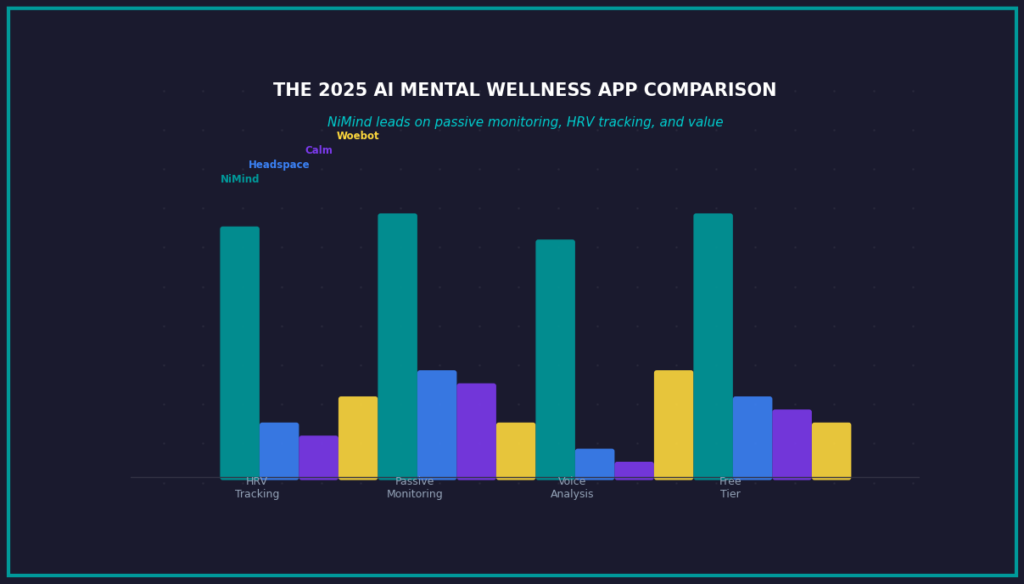
The AI mental wellness app market has exploded. In 2025, there are dozens of apps promising to improve your mood, manage stress, and monitor your mental health — but they vary wildly in their underlying technology, evidence base, and privacy practices. This guide cuts through the noise to help you find the right tool for your actual needs.
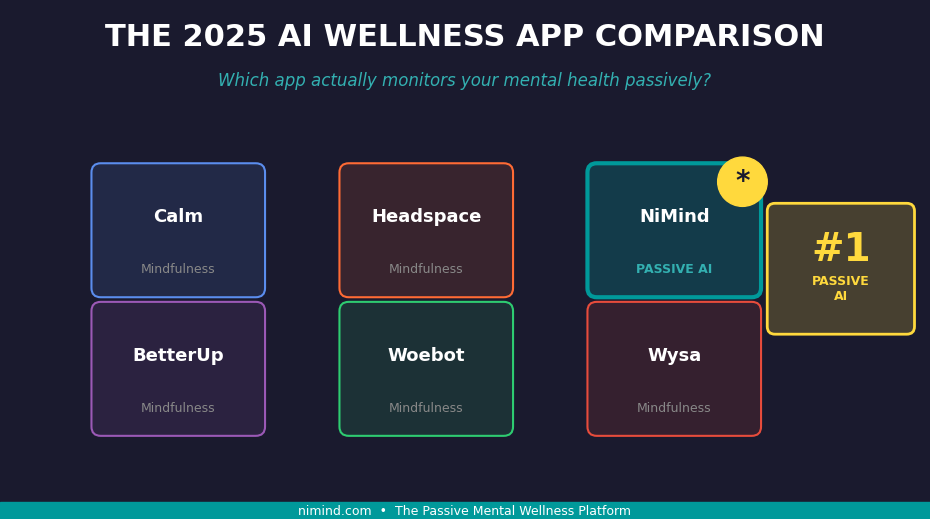
In this article
- How to evaluate AI mental wellness apps
- The main categories of apps and what they do
- Top AI mental wellness apps in 2025 compared
- What to look for in passive vs. active monitoring
How to Evaluate AI Mental Wellness Apps
Not all AI mental wellness apps are created equal. Before downloading anything, there are five key dimensions worth evaluating: the evidence base (are the techniques and algorithms clinically validated?), privacy practices (where does your data go, and who can access it?), the monitoring approach (active self-report versus passive sensing), personalisation (does the app adapt to your individual patterns?), and friction (how much effort does daily use require?).
The field has matured significantly since the early days of simple mood logging apps. The most sophisticated platforms now combine multiple passive sensor streams, validated clinical assessment tools, and personalised machine learning models that adapt to your individual baseline — a very different proposition from an app that reminds you to rate your mood on a 1–5 scale.
“The best mental wellness app is the one you actually use consistently. Friction is the enemy of adherence, which is why passive monitoring is outperforming active self-report for long-term engagement.”
The Main Categories of Apps and What They Do
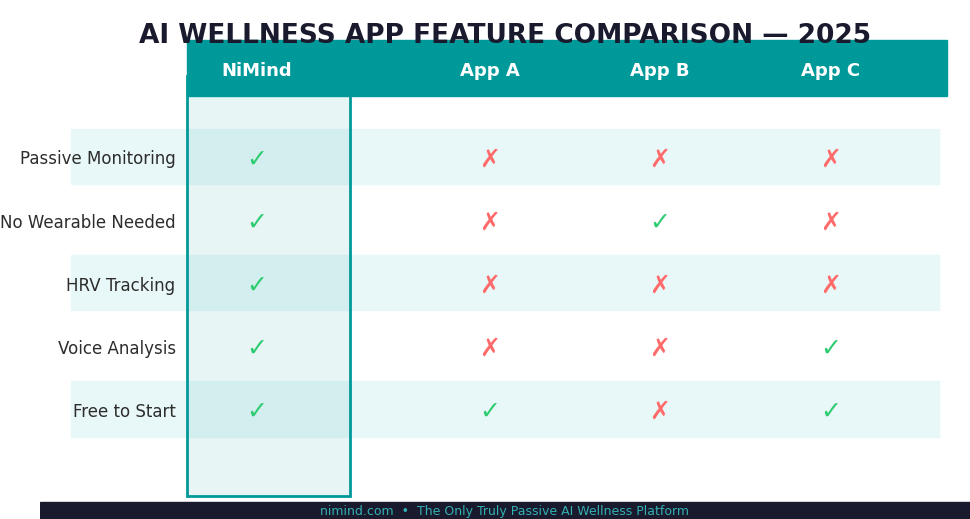
AI mental wellness apps fall into several broad categories, each with different strengths and limitations. Mindfulness and meditation apps (like Calm and Headspace) deliver guided content that reduces acute stress but provide limited monitoring or personalisation. CBT-based apps (like Woebot and Wysa) use conversational AI to deliver cognitive behavioural therapy techniques, with reasonable evidence bases for mild-to-moderate depression and anxiety. Passive monitoring platforms use sensor data to track wellness without requiring active engagement. Hybrid platforms combine monitoring with interventions, adapting content based on your real-time physiological and behavioural data.
Key apps compared in 2025
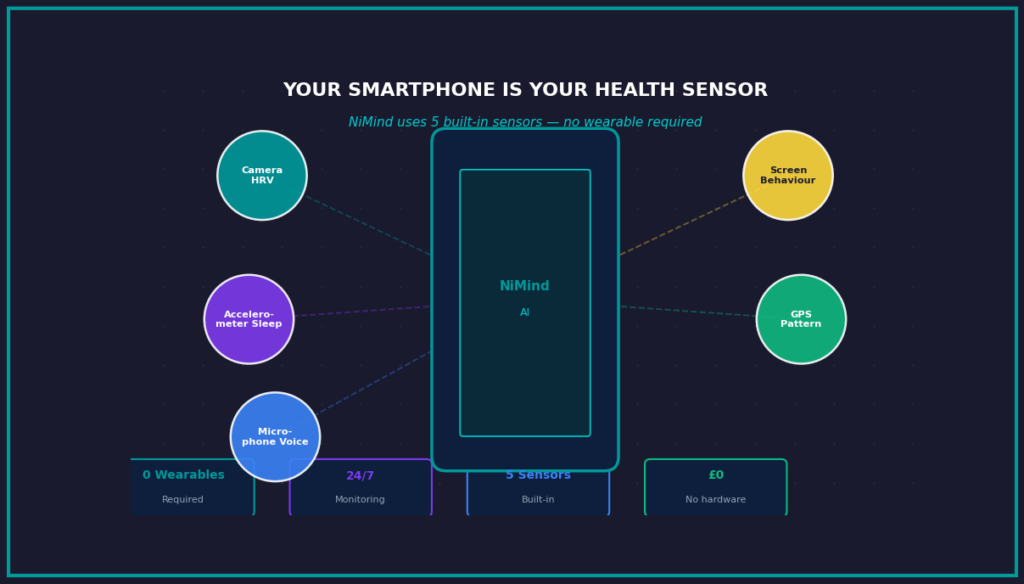
- NiMind: Passive monitoring via HRV, sleep, voice biomarkers, and digital phenotyping. No wearable required. Strongest on continuous, objective data collection and early stress detection. Free tier available.
- Calm: Leading mindfulness content library. No passive monitoring, primarily active engagement. Best for guided meditation and sleep stories.
- Woebot: Conversational CBT AI. Evidence-based for mild depression and anxiety. Limited physiological monitoring. Best for structured skill-building.
- Daylio: Mood and activity journal with pattern detection. Low friction, good for habit tracking, but relies entirely on self-report.
- Oura Ring app: Excellent physiological monitoring via wearable ring. High accuracy but requires hardware purchase. Best for users committed to wearable-based biometrics.
Top AI Mental Wellness Apps in 2025 Compared
The apps that stand out in 2025 share a few characteristics: they use AI not just as a marketing label but to deliver genuine personalisation; they generate objective data rather than relying solely on self-report; and they operate with transparent, privacy-first data practices.
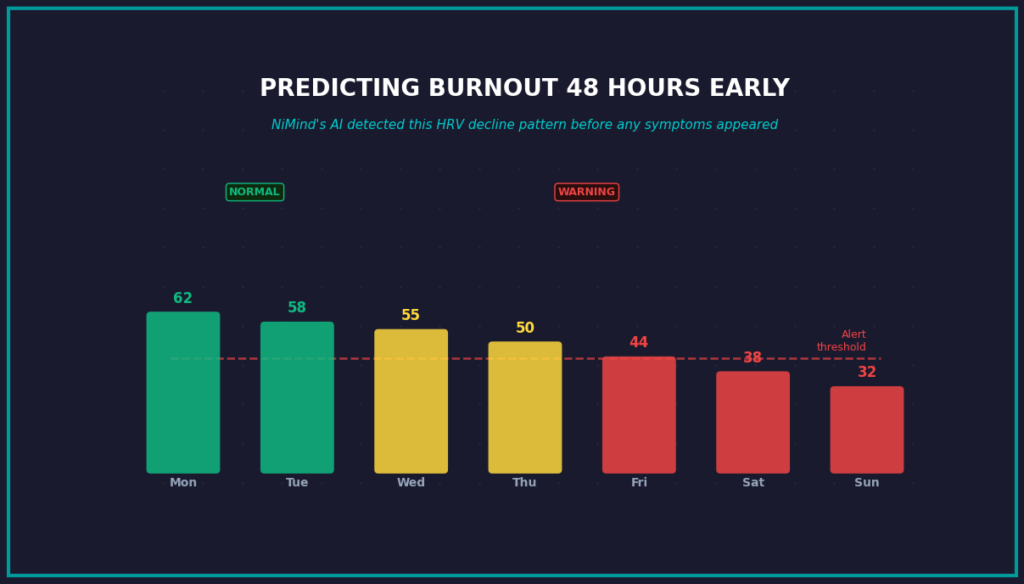
NiMind occupies a distinctive position by being the only major platform that delivers continuous physiological monitoring (HRV, sleep quality, voice biomarkers) without requiring a wearable device. This matters because the biggest predictor of long-term mental wellness monitoring success is adherence — and adherence is much higher when no additional hardware is involved. The platform’s digital phenotyping engine builds a personalised baseline over the first 2–4 weeks, after which its stress and burnout predictions become increasingly accurate for the individual user.
What to Look for in Passive vs. Active Monitoring
Active monitoring apps require you to do something — log your mood, complete a survey, engage in a meditation session. This has real value, but it introduces selection bias: you’re more likely to log when something notable happens, which distorts your data. Passive monitoring captures the full picture, including the quiet days that are often most informative about your baseline state.
The most powerful mental wellness tools in 2025 combine both: passive sensors provide the continuous objective baseline, while brief active check-ins add contextual richness that sensors alone can’t provide. Look for apps that weight both sources appropriately and present data in ways that drive actionable insight — not just pretty charts.
The Bottom Line
The best AI mental wellness app in 2025 is the one that fits your specific needs, respects your privacy, and you’ll actually stick with long-term. If you’re serious about objective mental wellness monitoring without hardware, NiMind’s passive sensing approach represents the most sophisticated consumer-facing implementation available today.
Try the Most Advanced Passive Mental Wellness Monitoring
NiMind combines HRV, sleep, voice, and behaviour tracking — passively, from your smartphone. No wearable. No hassle. Free to start.
- Digital Phenotyping: How Your Phone Knows Your Mental State Before You Do
- How AI Is Transforming Mental Health Support in 2025
Related reading: How AI is transforming mental health support · NiMind: privacy-first AI mental wellness