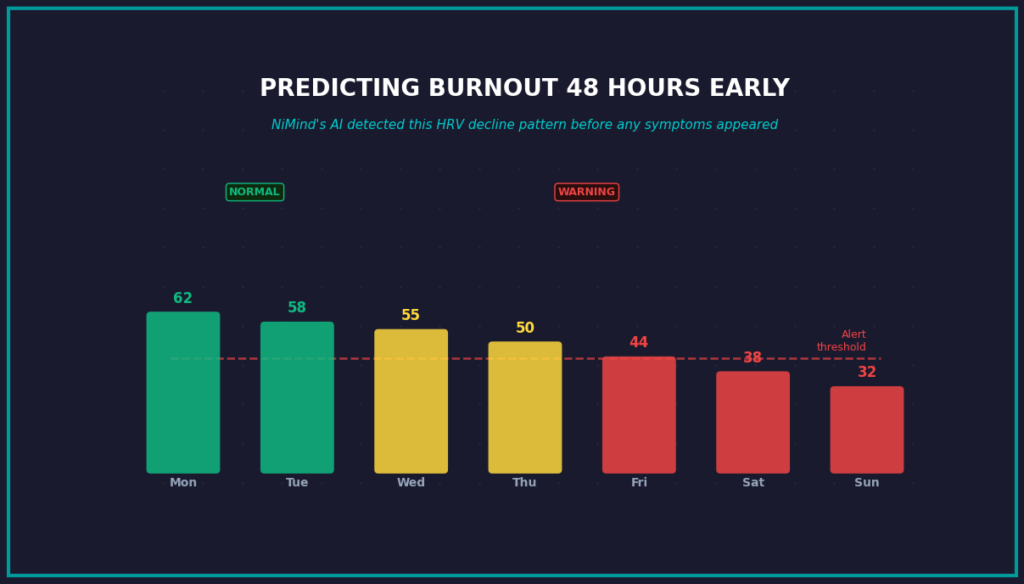
The wearable health tracker market is worth billions — but the uncomfortable truth is that most people stop wearing their devices within a few months. The charge runs out, the band irritates their skin, they forget, they lose motivation. Meanwhile, the smartphone in their pocket — charged every night, carried everywhere, interacted with 150 times a day — quietly collects more meaningful health data than most wearables ever will. Passive smartphone health tracking is the category that’s about to change everything.
In this article
- Why wearables have an adherence problem
- What your smartphone can track passively
- The accuracy of smartphone-based health monitoring
- Getting started with passive health tracking today
Why Wearables Have an Adherence Problem
Consumer research consistently shows that 30–50% of fitness tracker owners stop using their devices within 6 months of purchase. The reasons are well-documented: charging fatigue, comfort issues during sleep, social awkwardness, loss of novelty, and the simple friction of remembering to wear an additional device every day. This adherence problem is particularly acute in health monitoring contexts, where the people who most need continuous tracking — those experiencing chronic stress, mental health challenges, or early signs of burnout — are often the least able to maintain consistent wearable use.
The result is a systematic data gap: the readings that would be most clinically informative — during periods of high stress, illness, or sleep disruption — are precisely when wearable devices are most likely to be forgotten, uncharged, or uncomfortable. Passive smartphone tracking suffers from none of these limitations.
“The wearable you don’t wear generates zero data. The smartphone you never put down generates it continuously — and increasingly, that data is just as valuable.”
What Your Smartphone Can Track Passively
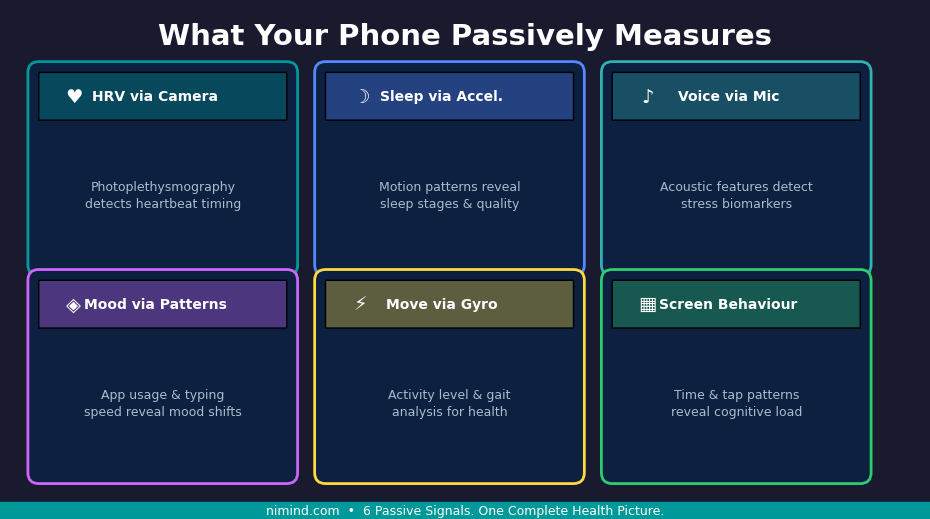
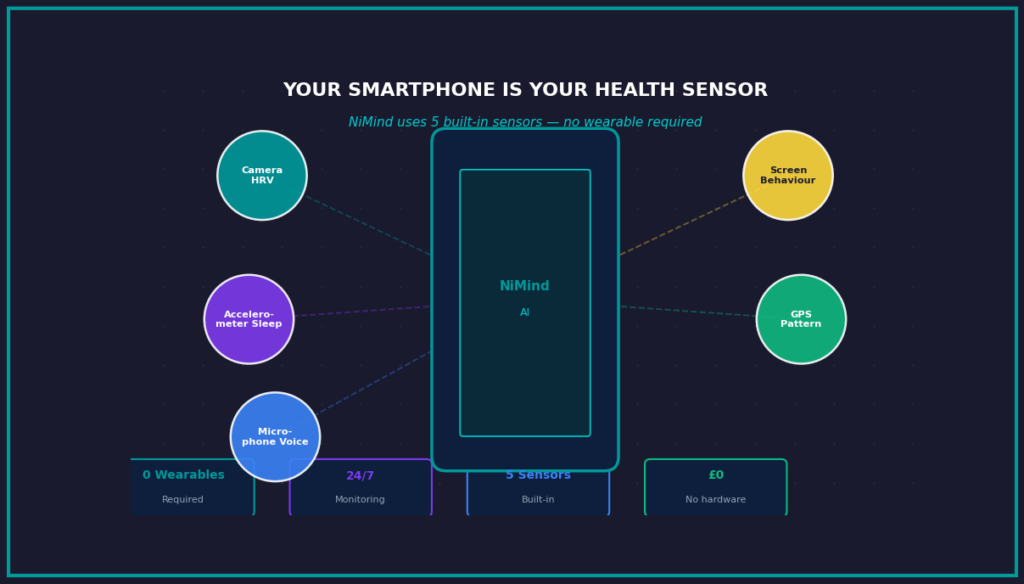
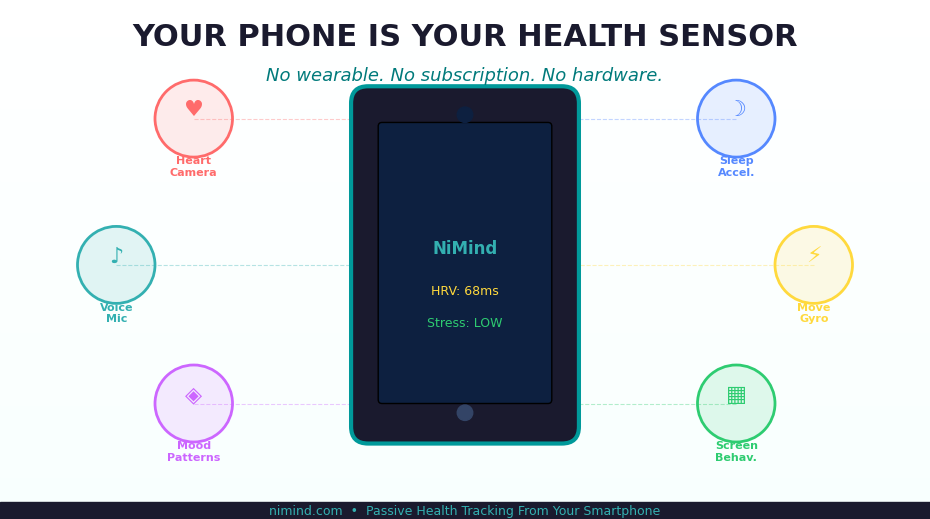
Modern smartphones contain a sophisticated array of sensors that, when analysed intelligently, reveal a rich picture of health and wellness. No additional hardware. No charging. No remembering. Just the device you already use every day.
Smartphone sensors and what they measure
- Accelerometer and gyroscope: Physical activity levels, gait analysis, sleep movement, sedentary behaviour, and circadian activity patterns
- Microphone: Breathing rate estimation during sleep, vocal biomarkers of stress and mood, ambient noise levels that affect sleep quality
- Camera PPG: Heart rate and HRV measurement via finger placement on camera lens — takes 60 seconds and produces clinical-grade accuracy
- GPS: Mobility patterns and activity radius — a sensitive indicator of motivation, depression, and social engagement
- Screen interaction: Usage patterns, session frequency, and app behaviour that reflect cognitive state, mood, and behavioural changes
- Barometer and light sensor: Environmental context that aids sleep stage estimation and circadian pattern analysis
The Accuracy of Smartphone-Based Health Monitoring
The legitimate question is: how accurate is passive smartphone health tracking compared to dedicated wearables or clinical measurements? The honest answer is: it depends on what you’re measuring and how you’re measuring it, but the gap has narrowed dramatically in recent years — and for trend monitoring, it’s often negligible.
For HRV measurement specifically, camera-based PPG (60-second finger-on-camera readings) has been validated against ECG gold standard measurements with correlation coefficients of 0.85–0.95 across multiple independent studies. For sleep duration, passive smartphone monitoring typically achieves accuracy within 15–20 minutes of polysomnography for total sleep time — comparable to consumer wrist trackers.
Crucially, for trend-based monitoring — which is where the real clinical value lies — small absolute accuracy differences between measurement methods are largely irrelevant. What matters is consistency: measuring the same way every day so that changes in your metrics reliably reflect changes in your physiology, not variations in measurement method.
Getting Started with Passive Health Tracking Today
The barrier to entry for passive smartphone health tracking is essentially zero. You need a smartphone (iOS or Android), a compatible app, and the willingness to spend one week establishing your baseline before interpreting any results. The one-week baseline period is important: single readings are almost meaningless; trends and deviations from your personal pattern are what generate genuine insight.
NiMind is designed specifically for passive smartphone health tracking, combining HRV monitoring, sleep analysis, voice biomarker tracking, and digital phenotyping into a single platform that builds your personal wellness baseline automatically. The app runs in the background, requires no active engagement beyond a brief morning voice check-in, and surfaces insights in a daily wellness summary that takes 30 seconds to review.
The Bottom Line
You don’t need a wearable to track your health seriously. The smartphone in your pocket already contains the sensors needed for meaningful, continuous health monitoring — it just needs the right software to make that data actionable. Passive health tracking from your smartphone removes every barrier that causes wearable abandonment, while delivering data that is, for trend monitoring purposes, just as informative as most dedicated devices.
Turn Your Smartphone Into a Passive Health Monitor
NiMind tracks HRV, sleep, voice biomarkers, and behaviour passively from your smartphone. No wearable needed. No hardware cost. Free to start.
- What Is Passive HRV Monitoring — And Why It Beats Wearables
- Digital Wellbeing for Busy Professionals: 5 Passive Habits That Actually Work
Related reading: 5 wellness signals your phone already collects · Passive HRV monitoring vs. wearables