Busy professionals face a paradox: the people who most need to monitor their mental health are often the least able to carve out time to do it. Lengthy mindfulness sessions, daily journalling, and regular therapy appointments all require active engagement that competes with an already overcrowded schedule. Passive digital wellbeing habits offer a different path — one that requires almost no additional time while delivering continuous, objective insight into your mental and physical state.
In this article
- Why traditional wellbeing approaches fail busy professionals
- The 5 passive habits that actually work
- Building a passive wellbeing stack
- What the data tells you — and what to do with it
Why Traditional Wellbeing Approaches Fail Busy Professionals
The wellbeing industry has largely been designed for people with discretionary time. Meditation apps assume you have 10 undisturbed minutes each morning. Journalling systems assume you want to sit with your thoughts each evening. Exercise trackers assume you’re motivated by gamified step counts. These are fine for certain populations, but they fail systematically for professionals operating under sustained high load — precisely the group most at risk of burnout.
The fundamental issue is friction. Every moment of active engagement with a wellbeing tool is a moment that competes with work, family, rest, and everything else. Passive approaches — where monitoring and insight generation happen automatically in the background — remove this friction entirely, making consistent data collection possible even during the most demanding professional periods.
“The best wellbeing habit for a busy professional is one they don’t have to remember to do. Passive monitoring is the only approach that meets that standard.”
The 5 Passive Habits That Actually Work
1. Passive HRV monitoring via smartphone
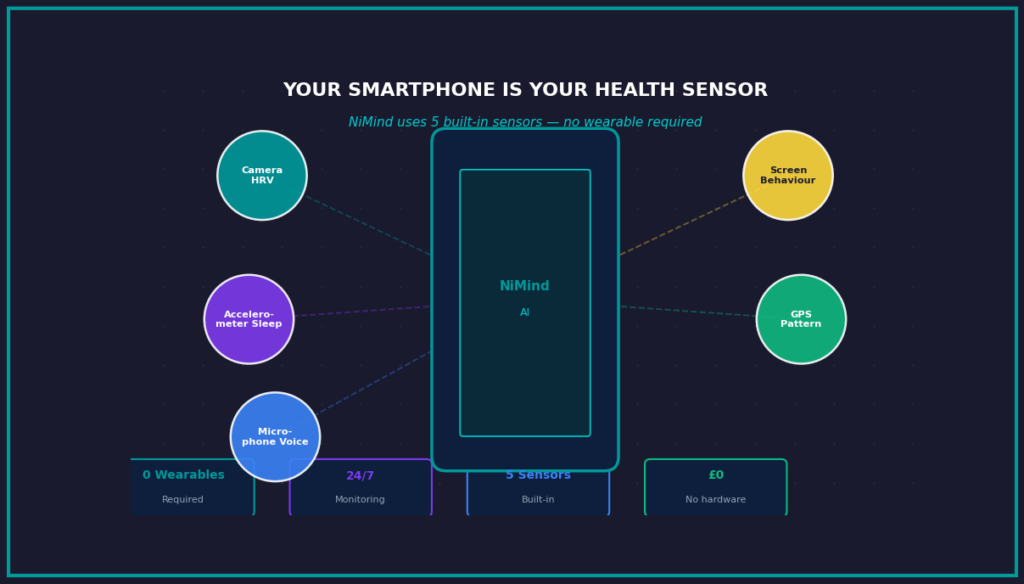
Place your phone on your bedside table overnight and let it collect sleep and HRV data automatically using accelerometer and microphone-based analysis. No action required beyond your normal routine. Over 2–4 weeks, you’ll have a personal baseline that can flag weeks of declining recovery before you consciously notice fatigue accumulating.
2. Brief morning voice check-in (30 seconds)
A 30-second voice recording each morning — simply describing how you slept or how you’re feeling — provides acoustic data that correlates with stress levels, sleep quality, and cognitive readiness. Apps like NiMind process these recordings for voice biomarkers in the background. The effort is comparable to your first sip of coffee.
3. Behavioural pattern monitoring
Allow your mental wellness app to passively analyse your mobility patterns, screen time, and app usage cadence. These digital phenotyping signals require zero active engagement and provide reliable early indicators of stress escalation, social withdrawal, and mood change.
4. Weekly data review (10 minutes)
This is the one active habit worth building. Set aside 10 minutes on a Sunday to review your previous week’s wellness data. Look for patterns, anomalies, and trends. This context-setting habit turns raw monitoring data into actionable self-knowledge, without requiring daily engagement.
5. Notification-triggered micro-interventions
Configure your wellness app to send data-driven nudges at meaningful moments — a breathing prompt when your HRV suggests acute stress, a movement reminder when your activity drops below baseline. These micro-interventions take 60–90 seconds and are triggered by real physiological data rather than arbitrary timers.
Building a Passive Wellbeing Stack
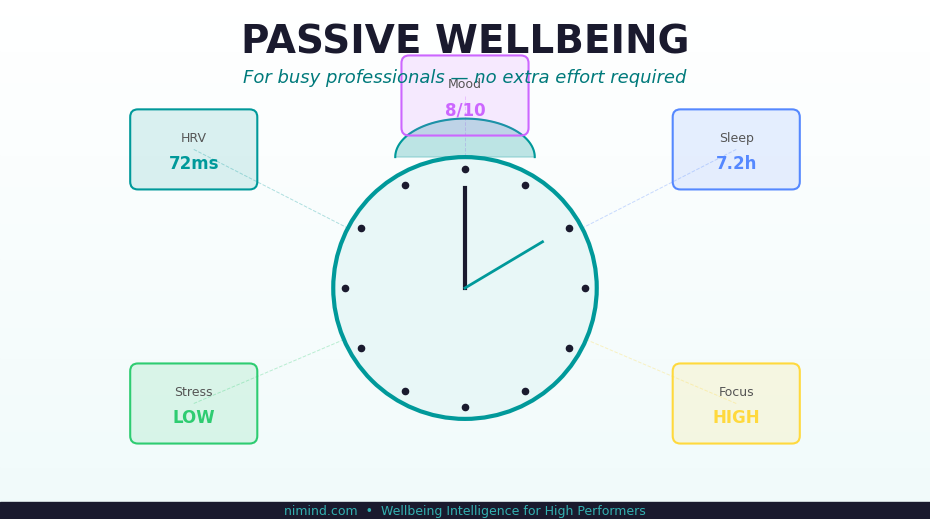
The key to a sustainable passive wellbeing practice is minimising the number of apps and devices involved. A single well-designed platform that handles HRV monitoring, sleep tracking, voice biomarkers, and behavioural analysis is far more sustainable than cobbling together five separate tools. Look for a platform that presents unified insights — a daily wellness score or trend report — rather than requiring you to synthesise data from multiple sources.
What the Data Tells You — and What to Do With It
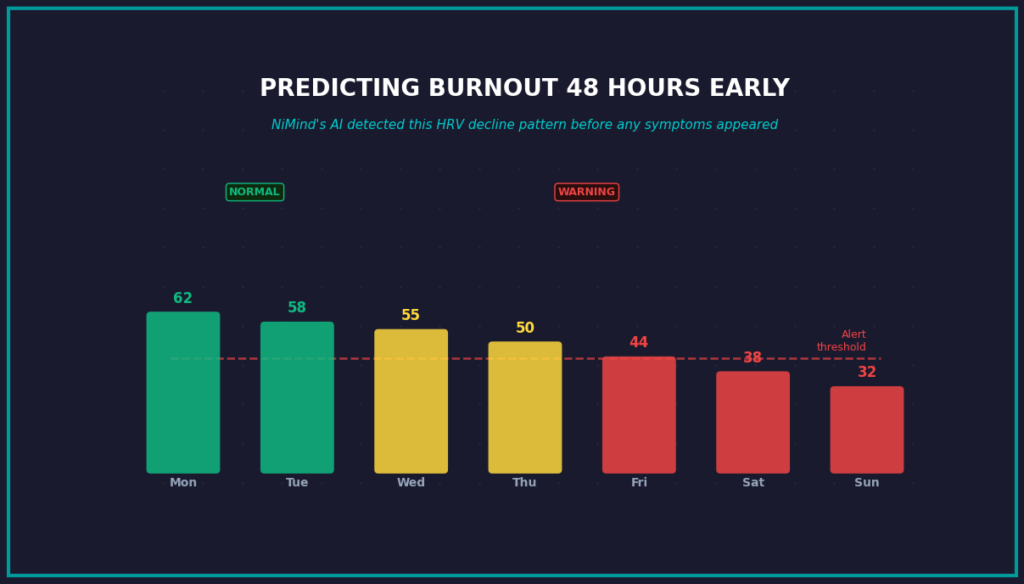
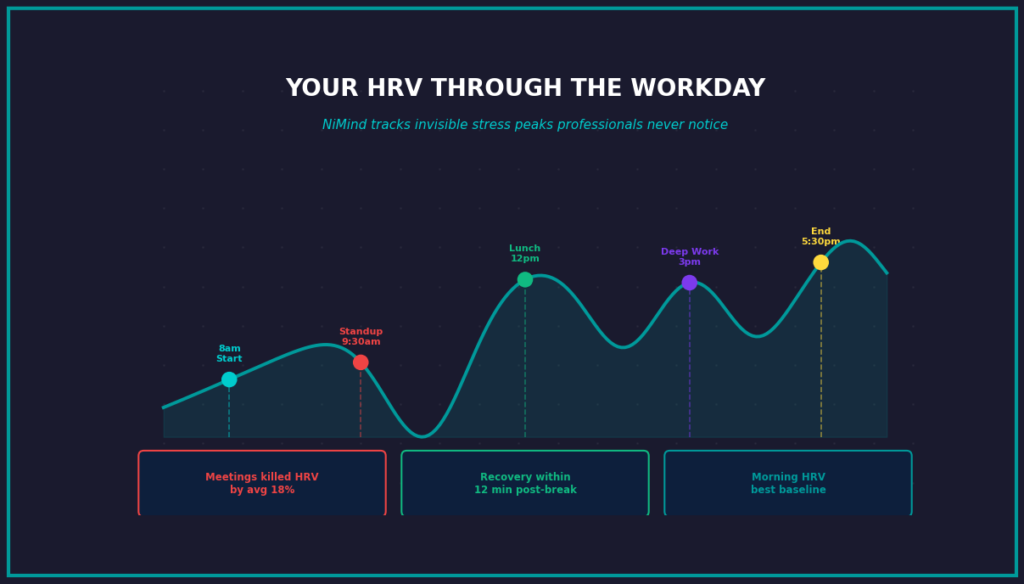
Passive monitoring data is most valuable as a trend indicator rather than an absolute measure. A single low HRV reading is meaningless; three weeks of declining HRV during a high-workload period is a clear signal to reduce load before burnout sets in. The actionable insight is not “your HRV is 32ms today” but “your recovery has been declining for 18 days and your current trajectory matches your pre-burnout pattern from last year.”
The Bottom Line
Digital wellbeing for busy professionals doesn’t have to mean more to-do items on an already overwhelming list. Passive monitoring — combined with brief, data-triggered micro-interventions — delivers the insights of a comprehensive wellness practice with a fraction of the active time commitment. The technology is available today, requires only your smartphone, and is free to start.
Passive Wellbeing Monitoring for Busy Professionals
NiMind monitors HRV, sleep, voice, and behaviour passively — so you get continuous wellness insights without disrupting your schedule. No wearable. Free.
- No Wearable? No Problem: Passive Health Tracking from Your Smartphone
- Morning Routine for Mental Wellness: What the Data Says
Related reading: Morning routine for mental wellness: what the data says · 5 wellness signals your phone collects