Most people assume tracking heart rate variability (HRV) requires a chest strap, a smartwatch, or some clip-on sensor. But the fastest-growing category in digital health is passive HRV monitoring — technology that reads your body’s signals in the background, without you lifting a finger. And the results are turning heads in clinical research.
In this article
- What passive HRV monitoring actually is
- How it differs from wearable-based tracking
- The science: what your HRV reveals
- Why passive monitoring is the future of mental wellness
What Passive HRV Monitoring Actually Is
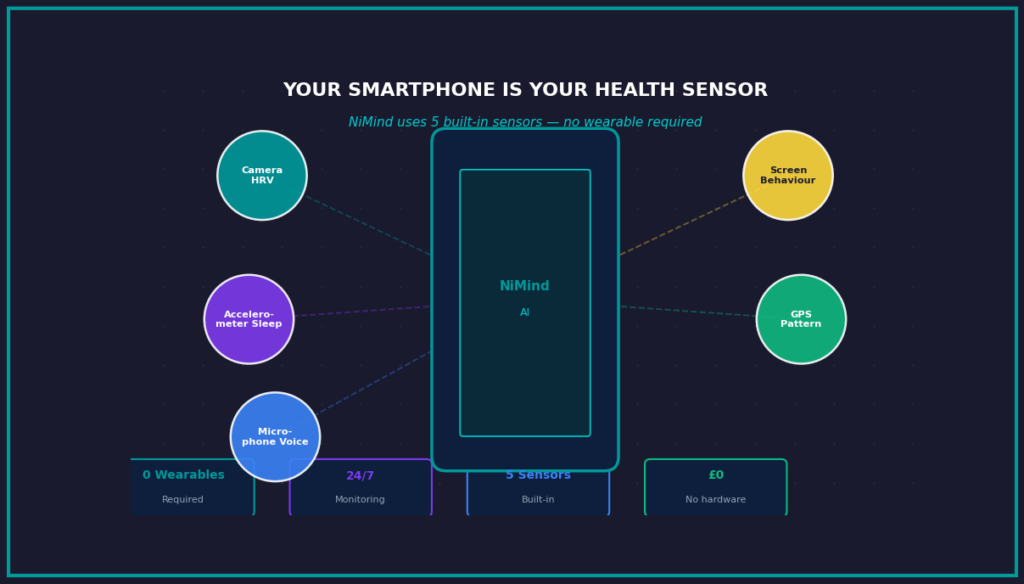
Passive HRV monitoring refers to the measurement of heart rate variability using signals that are captured without the user actively engaging in a measurement session. Unlike traditional methods — where you strap on a monitor and sit still for five minutes — passive approaches work continuously in the background, using smartphone cameras, microphones, motion sensors, or even behavioral patterns to infer cardiovascular status.
The most promising passive methods include photoplethysmography (PPG) via smartphone cameras, which can detect subtle color changes in skin caused by blood flow, and seismocardiography using phone accelerometers to detect chest vibrations during sleep. Some platforms also use voice acoustic analysis, typing rhythm, and app usage cadence as indirect HRV proxies.
“Passive monitoring captures your physiological baseline in real life — not in an artificial 5-minute measurement window that tells you very little about your daily stress load.”
How It Differs From Wearable-Based Tracking
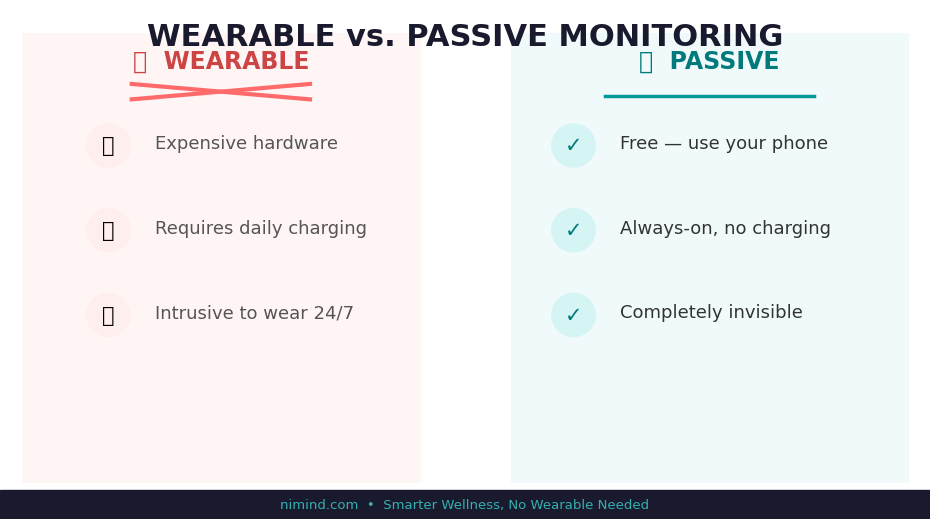
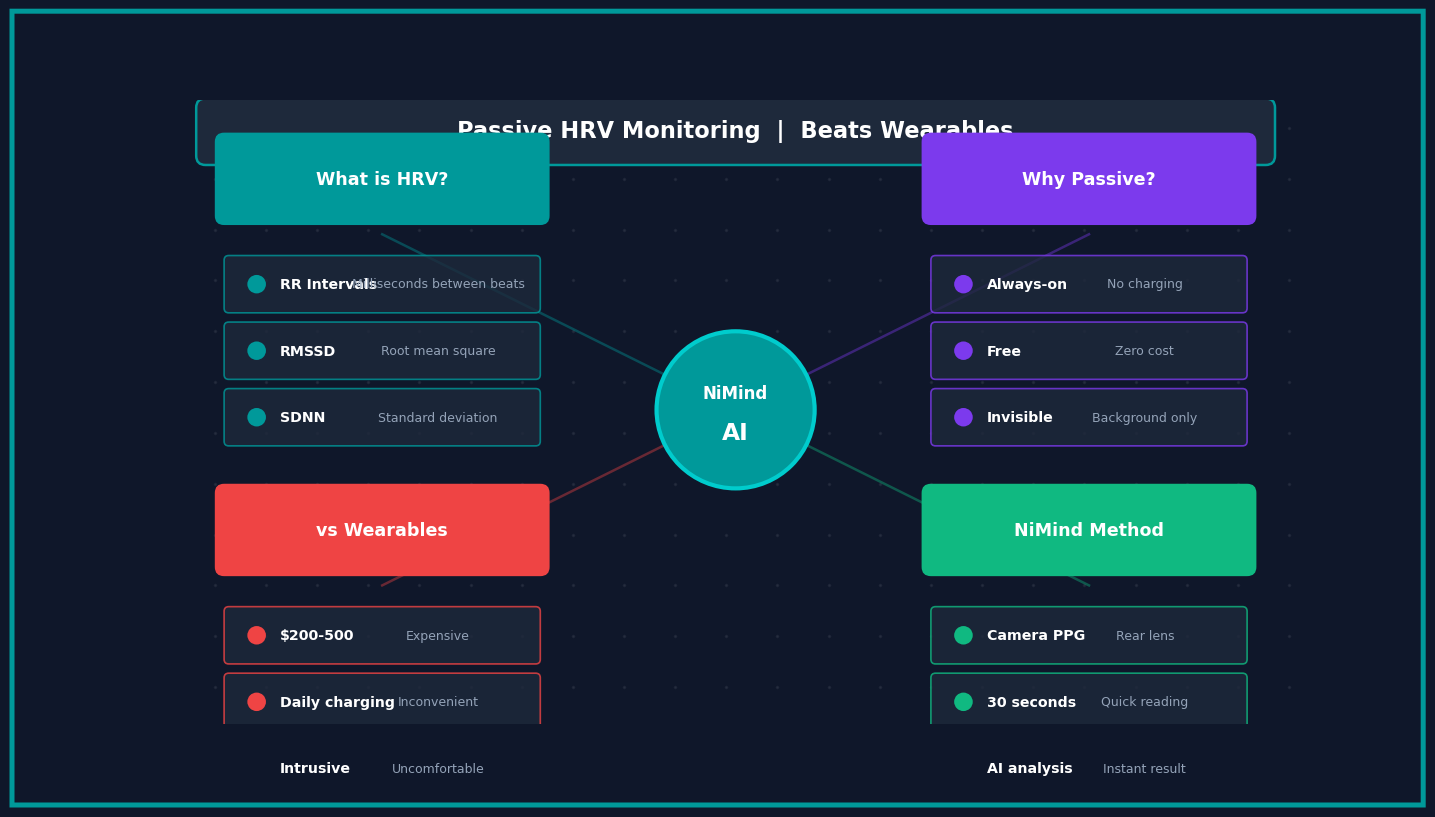
Traditional wearables like the Apple Watch, Garmin, or Polar chest straps require you to wear a device, charge it regularly, and — critically — remember to use it. Studies show that wearable adherence drops sharply after the first few weeks. People forget to charge them. They feel uncomfortable sleeping in them. They leave them on the charger the one night their sleep is most disrupted.
The adherence problem
Passive monitoring sidesteps this entirely. Your phone — which most people sleep next to, carry all day, and interact with hundreds of times daily — becomes the sensor platform. No additional hardware, no charging, no remembering. The data flows continuously and unobtrusively.
- No hardware cost: Passive monitoring uses devices people already own
- No adherence drop-off: Data is captured automatically, even on bad days
- Richer context: Behavioral signals complement physiological ones
- Longitudinal baselines: Months of data enable better anomaly detection
The Science: What Your HRV Reveals
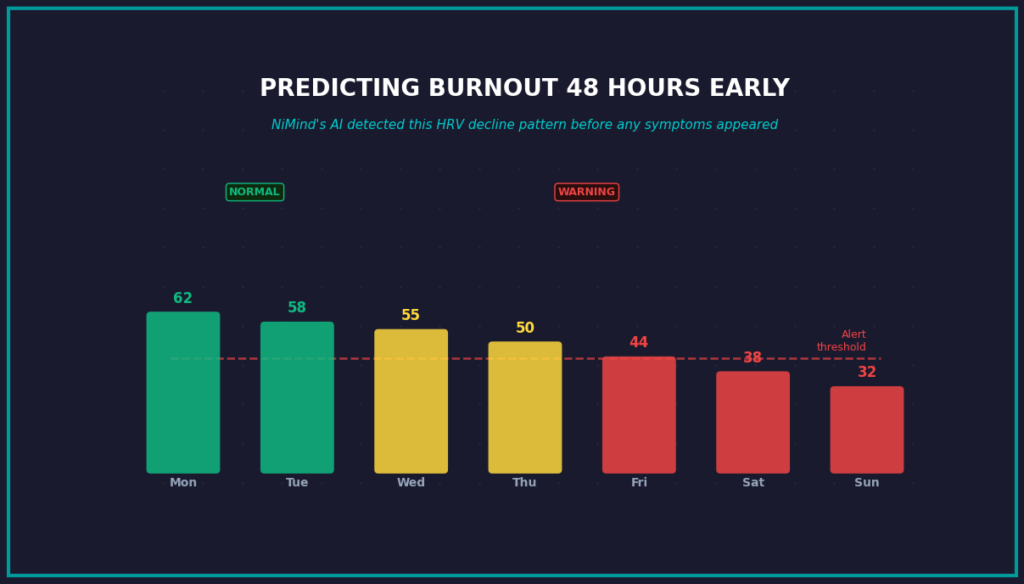
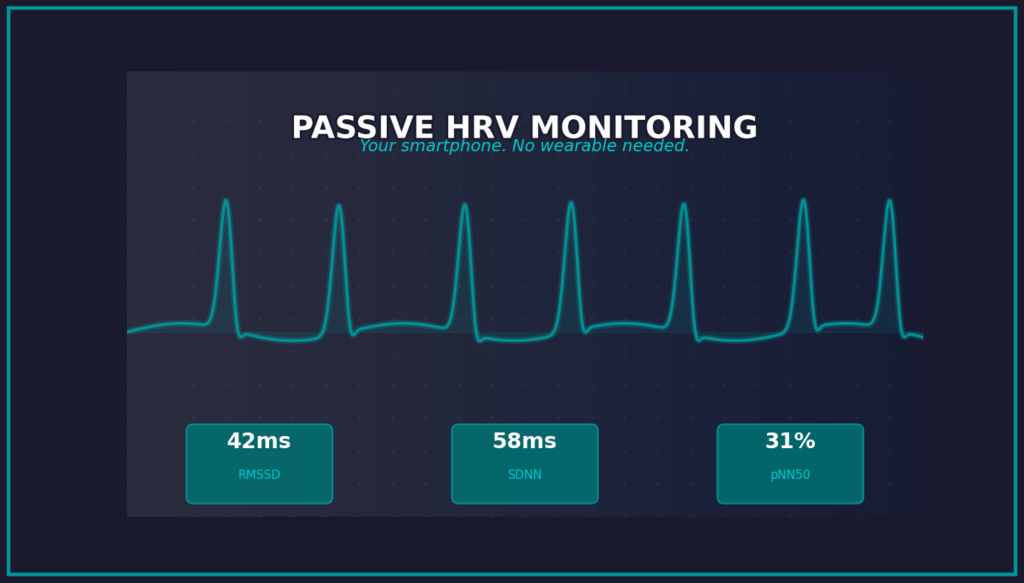
Heart rate variability is the variation in time between successive heartbeats, measured in milliseconds. A higher HRV generally indicates a well-regulated autonomic nervous system — your body is balanced between its fight-or-flight (sympathetic) and rest-and-digest (parasympathetic) states. A declining HRV over days or weeks is one of the earliest objective signals of accumulating stress, poor recovery, or the onset of illness.
Research published in JMIR Mental Health found that passively collected HRV data from smartphone sensors could predict self-reported stress levels with over 75% accuracy when combined with behavioral features. This is comparable to — and in some studies superior to — dedicated wearable devices, largely because passive methods capture data across the full 24-hour cycle rather than in isolated snapshot readings.
Why Passive Monitoring Is the Future of Mental Wellness
The mental health crisis is partly a detection problem. Most people don’t recognise burnout, anxiety escalation, or depressive episodes until they are already deep in them. Passive HRV monitoring creates a continuous early-warning system — an objective physiological record that can alert you (or your care team) to changes before subjective symptoms become overwhelming.
Apps like NiMind are pioneering this approach, using passive smartphone signals to build personal HRV and wellness baselines that evolve daily. The result is a mental wellness picture that is both more accurate and more actionable than a weekly mood check-in or a wearable you forgot to charge.
The Bottom Line
Passive HRV monitoring represents a genuine leap forward in how we can track mental and physical wellness. By removing the friction of wearable hardware and leveraging the smartphone you already carry everywhere, it delivers richer, more continuous data — and that data can catch stress and burnout signals that traditional methods miss entirely.
Track Your HRV Passively — No Wearable Needed
NiMind monitors HRV, sleep, voice biomarkers and mood using just your smartphone. No wearable needed. Free to try.
- What Is HRV? A Plain-English Guide to Heart Rate Variability
- HRV and Anxiety: What Heart Rate Variability Tells You About Your Stress
Related reading: What is HRV? A plain-English guide · HRV and anxiety: what it reveals about stress